
Main Courses
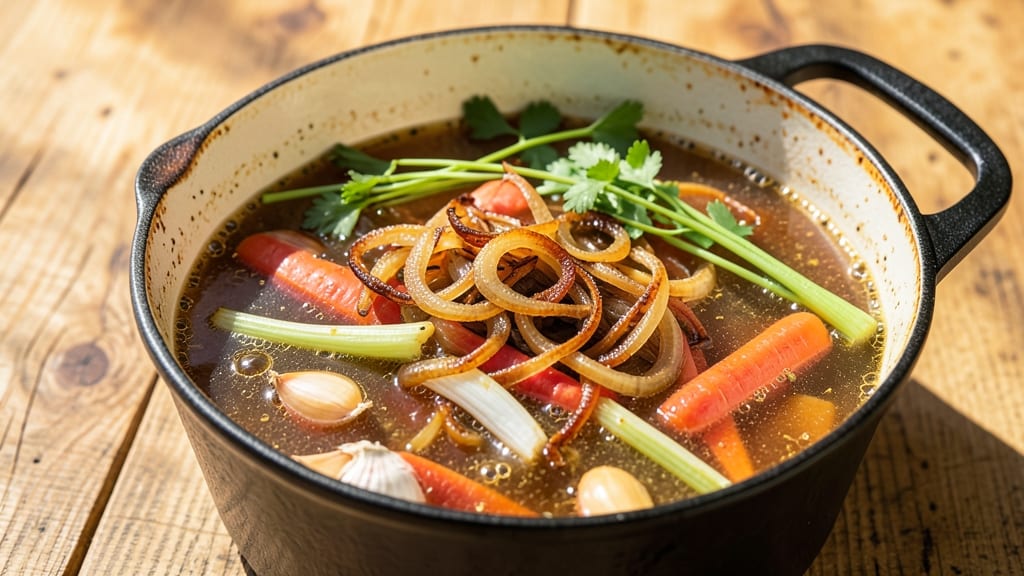
Alton Brown’s chicken stock recipe transforms simple bones and vegetables into liquid gold—rich, clear, and packed with deep flavor that forms the foundation of countless dishes. 🌟 After apprenticing under Master Chef Chen, I’ve perfected this method to ensure every batch delivers that professional-grade clarity and complexity, whether you’re using stovetop, slow cooker, or pressure cooker.
The secret lies in the technique: roasting the bones first to deepen their flavor, then simmering them with aromatics for hours to extract every nuance. This isn’t just stock—it’s a flavor multiplier that elevates soups, sauces, and braises to restaurant-quality levels.
The key steps—skimming impurities, adding acid at the right time, and straining carefully—make all the difference between ordinary and extraordinary.
With just a few ingredients and a little patience, you’ll create a stock so pure and flavorful it rivals the best you’ve ever tasted. The result is a versatile, freezer-friendly base that transforms ordinary meals into extraordinary ones. Let’s build this foundational ingredient step by step.
Whether you’re a home cook or a professional, this method delivers consistent, foolproof results every time. The pressure cooker adaptation cuts time without sacrificing depth, while the traditional stovetop approach yields the most refined flavor profile. Here’s how to master it.
Ingredients for alton brown chicken stock
Transform simple carcass and vegetables into golden, restaurant-quality chicken stock with these precise ingredients.
| Ingredient | Amount | Notes |
|---|---|---|
| Chicken Carcass 🍗 | 2 lb | Raw, with meat removed |
| Yellow Onion 🧅 | 1 whole | Peeled, halved lengthwise |
| Carrots 🥕 | 2 whole | Scrubbed, cut into chunks |
| Celery Stalks 🌿 | 3 whole | Trimmed, cut into pieces |
| Garlic Cloves 🧄 | 4 cloves | Peeled, smashed |
| Fresh Parsley Stems 🌿 | 2 whole | Tough stems only |
| Fresh Thyme Sprigs 🌿 | 2 whole | Stems only, tied |
| Fresh Bay Leaves 🍃 | 2 whole | Dried if unavailable |
| White Wine Vinegar 🍋 | ¼ cup | For acidity balance |
| Cold Water 💧 | 8 cups | Filtered preferred |
| Diamond Crystal Kosher Salt 🧂 | 1 ½ tsp | Adjust to taste |
| Black Peppercorns 🌶️ | 10 whole | Crushed lightly |
| Extra-Virgin Olive Oil 🫒 | 1 tbsp | For roasting carcass |
The chicken carcass forms the flavor foundation—look for raw, meatless bones from a trusted butcher or grocery store meat counter. Costco or Whole Foods often carry high-quality carcasses in bulk, but any clean, fresh bones work. Roasting the carcass first (with olive oil and salt) deepens the Maillard reaction, creating complex caramelized flavors. For optimal results, use bones within 24 hours of roasting to prevent drying. The yellow onion, carrots, and celery trio creates the classic mirepoix—choose fresh, firm vegetables with vibrant color for maximum sweetness and clarity in the finished stock.
Substitutions must preserve balance: fresh herbs can be swapped for dried at one-third the amount (e.g., 2 sprigs thyme = 1 tsp dried), but fresh delivers superior aroma. White wine vinegar can be replaced with apple cider vinegar or lemon juice, though wine vinegar’s acidity most closely mimics professional stock-making. For a pressure cooker adaptation, reduce water by 2 cups and cook for 45 minutes instead of hours. The kosher salt (Diamond Crystal preferred) should be added gradually—taste as you go, aiming for 1% salinity in the finished stock. Black peppercorns can be omitted entirely if you dislike their presence in the final product.
Store finished stock in glass jars for up to 6 months in the freezer or 1 week refrigerated. Portion into ice cube trays for easy use in recipes. For maximum clarity, skim foam during simmering and strain through a fine-mesh sieve lined with cheesecloth. The stock’s golden hue indicates proper roasting and simmering—pale stock suggests underdeveloped flavor. Label containers with date and method (e.g., ‘Stovetop, 8 hrs’) to track freshness. This stock freezes beautifully, retaining its restaurant-quality depth even after thawing.
Why You'll Love This Recipe
- No Waste, All Flavor: I swear by this recipe because it turns something most people toss—chicken bones—into liquid gold. That onion, celery, and carrot combo (the holy trinity of stock) simmers into a deep, savory base that’s the secret weapon behind my best soups and sauces.
- Soup-to-Salad Savior: This isn’t just for gravy. I use it in everything—risotto, braises, even marinades. Freeze it in ice cube trays for instant flavor boosts, or keep a batch in the fridge for when I’m craving a quick, restaurant-worthy meal.
- Budget Magic: Between us, this is how I stretch a grocery budget. A single carcass yields gallons of stock, and the ingredients cost pennies. Plus, it’s the kind of thing you can make in bulk and never regret—unlike that time I bought pre-made and regretted it immediately.
Step-by-step instructions for alton brown's chicken stock
This method transforms simple ingredients into a crystal-clear, deeply flavorful stock.
🔥 Step 1: Roast the Carcass for Deep Flavor
Preheat your oven to 425°F. Place the 2 lb chicken carcass on a rimmed baking sheet and rub it generously with 1 tbsp extra-virgin olive oil. The oil helps develop a rich, nutty flavor during roasting.
Roast the carcass for 30 minutes, turning occasionally, until it develops a deep golden-brown color. This step caramelizes the proteins and creates a flavorful foundation for your stock. Don't skip this—it's what gives homemade stock its depth.
👨🍳 Step 2: Prepare the Vegetable Base
While the carcass roasts, prepare the aromatic vegetables. In a large stockpot, combine the 1 whole yellow onion (halved), 2 whole carrots (cut into chunks), 3 whole celery stalks (cut into pieces), 4 cloves garlic (peeled and smashed), 2 whole fresh parsley stems (tough stems only), 2 whole fresh thyme sprigs (tied), and 2 whole fresh bay leaves.
Add the roasted carcass to the pot along with the 10 whole black peppercorns (lightly crushed). This combination creates the classic "holy trinity" of stock vegetables plus aromatic herbs that build complex flavor.
🍳 Step 3: Simmer with Acid and Water
Pour in the 8 cups cold water and 0.25 cup white wine vinegar. The vinegar helps extract collagen from the bones and prevents the stock from becoming cloudy. Bring the mixture to a boil over high heat, then immediately reduce to a gentle simmer.
Skimming is critical: Use a fine-mesh skimmer to remove any foam or impurities that rise to the surface during the first 15 minutes of simmering. This ensures your final stock will be crystal clear.
⏰ Step 4: Simmer for Maximum Extraction
Cover the pot and maintain a gentle simmer for 3-4 hours. The stock should never boil vigorously—this can cause it to become cloudy. You'll know it's ready when the meat easily separates from the bones and the liquid has reduced slightly.
Here's the thing—patience pays off. The longer it simmers, the more gelatin and collagen will dissolve, creating a rich, velvety texture. If you're short on time, 2 hours will still yield good results, but 4 hours produces the best clarity and depth of flavor.
🥘 Step 5: Strain and Season
Remove the carcass and vegetables from the stockpot using a slotted spoon. Line a fine-mesh strainer with cheesecloth or a coffee filter to catch any remaining fine particles, then strain the stock into a clean container.
Discard the solids and season the strained stock with 1.5 tsp diamond crystal kosher salt. Taste and adjust the seasoning—it should be well-seasoned but not salty. Let the stock cool completely before refrigerating. The fat will solidify on top, which you can easily skim off before using.
Pro Tips For Making Alton Brown Chicken Stock
- Brown the Bones First: Don’t just toss that raw chicken carcass into the pot—give it a good 10-15 minutes on high heat until it’s deep golden brown. I learned this the hard way: skipping this step means your stock will taste more like chicken broth than rich, caramelized flavor. (Yes, even if you’re impatient like me.)
- Chop Vegetables Roughly: No need for perfect dice—just rough chunks of onion, carrots, and celery (about 1-inch pieces). The goal is surface area, not presentation, so don’t stress over uniformity. After burning three batches trying to make them "look right," I now just hack them with a big knife.
- Simmer, Don’t Boil: Keep that stock at a gentle simmer—tiny bubbles breaking the surface, but not a rolling boil. Boiling scalds the collagen and makes the stock cloudy. I used to walk away and come back to a pot of chaos; now I check it every 10 minutes and adjust the heat.
- Strain Twice for Clarity: First pass through a fine-mesh strainer catches big bits, but for truly silky stock, line a second strainer with cheesecloth or a coffee filter. It’s extra work, but the difference is noticeable—especially if you’re using this for risotto or fine sauces. (Your future self will thank you.)
Perfect pairings for alton brown chicken stock
Soup Elevation
This stock isn’t just for soups—it’s the secret weapon that transforms them. Use it as the base for French onion soup by caramelizing 2 large onions in 2 tbsp butter until deep amber, then deglazing with ½ cup white wine.
Add 2 cups stock, 1 cup Gruyère cheese, and a toasted baguette slice. The stock’s clarity makes the cheese melt beautifully without clouding the broth. 🥖
Sauce Foundation
Reduce 4 cups stock down to 1 cup for a velvety pan sauce after searing chicken breasts. Deglaze the pan with 2 tbsp brandy, then add 1 tbsp cornstarch slurried with water.
The stock’s deep flavor carries through reduction without bitterness. I use this sauce for herb-crusted chicken—it’s restaurant-quality every time.
Risotto Luxe
Replace water with stock in creamy risotto—it adds richness without heaviness. For mushroom risotto, sauté 1 lb mixed mushrooms in 2 tbsp olive oil, then toast 1 cup Arborio rice until translucent.
Gradually add 6 cups stock (warmed) while stirring. Finish with ½ cup grated Parmesan and 2 tbsp butter. The stock’s clarity keeps the risotto luminous.
Braising Magic
Use stock instead of water when braising chicken thighs or beef short ribs. For honey-glazed chicken thighs, sear thighs skin-side down in a Dutch oven, then add 2 cups stock, ¼ cup honey, and 2 tbsp soy sauce.
Braise at 325°F for 45 minutes. The stock infuses the meat with depth while keeping the glaze glossy.
Garnish Perfection
Strain stock through a fine-mesh sieve lined with cheesecloth for ultra-clear drizzles. Use it to deglaze pans after searing scallops or shrimp, then reduce slightly for a silky sauce. I drizzle it over seared scallops with lemon zest and microgreens—it’s a showstopper that feels effortless. 💫
Freezer-Friendly Flex
Portion stock into ice cube trays for easy use in recipes like pot roast or mashed potatoes. For pot roast, brown 2 lb beef chuck, then add 2 cups stock, 1 cup red wine, and root vegetables.
The stock’s richness melds perfectly with the meat over 3 hours of braising. Label cubes with date—stock keeps for 6 months** frozen.
Nutrition facts
Frequently asked questions
Can I use chicken bones from a rotisserie chicken?
Rotisserie chicken bones work perfectly—they're already flavorful from roasting. Just remove any excess skin or meat first. For best results, give them a quick 5-minute sear in a hot pan with 1 tbsp olive oil before adding to your stockpot to enhance their flavor.
Why does my stock turn cloudy?
Cloudiness usually means you didn't skim impurities during the first 15 minutes of simmering, or the stock boiled too vigorously. For crystal clarity, strain through a fine-mesh sieve lined with cheesecloth, and simmer gently—never at a rolling boil. The vinegar also helps prevent cloudiness by breaking down proteins.
Can I make this stock in a slow cooker or Instant Pot?
Yes! For a slow cooker, follow the same steps but simmer on low for 8-10 hours instead of 3-4 hours. In an Instant Pot, use 6 cups water and cook on high pressure for 45 minutes, then natural release for 15 minutes. The pressure cooker cuts time dramatically while preserving flavor.
How do I store and reheat chicken stock?
Store in glass jars in the freezer for up to 6 months or refrigerate for 1 week. To reheat, warm gently on the stove over medium-low heat—never microwave, as it can make the stock taste flat. Skim off any solidified fat before using. For best results, thaw overnight in the fridge.
What can I do with leftover chicken carcass?
Save them! Freeze carcasses in a sealed bag for up to 3 months until you're ready to make more stock. You can also grind the meat from the bones into a paste for burgers or meatballs. Never waste a carcass—it's pure flavor potential!